
Tools
On this page, I try to keep track of resources I think can be useful to psychiatry residents. In each section, I try my best to order by most important first.
Helper tools
Some of these are tools I made; fuller descriptions are on PROJECTS. (To be clear: no patient data is ever involved, not even anonymized, and not even on servers I run myself.)
I made psychiatheque, a search over psychiatry guidelines and recommendations that shows the matching passage on its original page, so you read the source itself rather than a summary. Public instance, source of the software.
I made justelesRCP to look up drug data faster: the official French RCP sheets (ANSM/BDPM/EMA open data, around 15,600 medications) as a fast, ad-free site with AI-based plain-language search. Source.
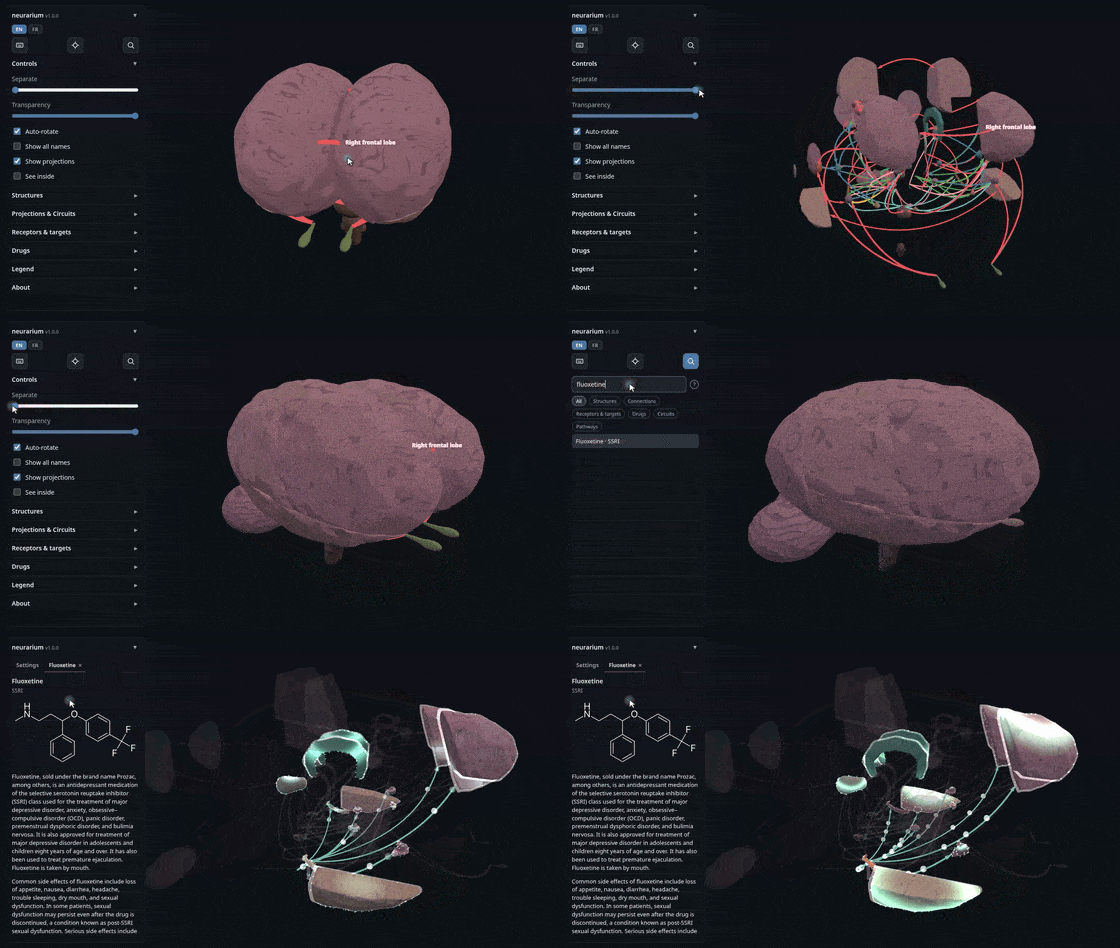
I made neurarium, a 3D neuroanatomy atlas covering regions, projections, receptors, psychiatric drugs and their metabolism, with a provenance grade on every entry so you can tell what is solid and what is not. Public instance, source.
At pdf.olicorne.org I host PDF tools (rotate, remove pages, split, merge, text recognition, etc.) that run entirely in your browser: your PDF never reaches a server. It is a BentoPDF instance.
I made WebSend to scan documents without a flatbed scanner: open the page on your phone and on the computer, and the photo transfers directly between the two, end-to-end encrypted. Public instance, source.
I made Parakeet Web to turn speech into text on locked-down machines: the model runs in the browser itself, so nothing is sent anywhere. It can load a French medical finetune I trained (model, from an open dataset I built for it): 7-8x fewer errors than the base model on technical medical vocabulary, with ordinary speech essentially unchanged. Both are freely licensed, so any team or vendor can reuse them rather than rebuild them. Public instance, source.
Prescribing
- Search by French indication by PsychoPharma.fr.
- Benzodiazepine equivalence by PsychoPharma.fr.
- mg/ml/drops conversion by PsychoPharma.fr.
- Antidepressant switch by PsychoPharma.fr, and an English version on Psychiatrienet. The two sometimes differ, so it is worth checking both.
- For prescribing to children and adolescents: Pharmacologie SFPEADA, by the Société Française de Psychiatrie de l’Enfant et de l’Adolescent.
General drug information
- ClinPGx (formerly PharmGKB) (described below).
- The
Résumé des Caractéristiques du Produitaccessed through the Base de données publique du médicament. - Vidal as well as Hoptimal Vidal (“hospital” version).
- To know which drugs are unavailable to patients: Disponibilité des produits de santé
- For the pharmacology of neurology and psychiatry drugs: the Collège National de Pharmacologie Médicale website.
Enzymatic interactions
- PharmFreq: nice widgets mapping the worldwide frequency of pharmacogenetic variants. Handy to weigh how likely a given metabolizer phenotype is for a patient depending on where their family comes from.
- Was recommended to me: DDI-Predictor, by the Hospices Civils de Lyon and / or University Claude Bernard Lyon I, Lyon, France.
- Seems rather complete and was recommended to me: ClinPGx (formerly PharmGKB).
- I noticed at least once a pretty wild oversimplification: the text on ClinPGx mentioned one cytochrome as being the main one, while the source actually explained that this one was actually the one that bound to the molecule the most but because it was less present it was actually not the main metabolizer of the given drug.
- My conclusion is that the most reliable way to check enzymatic drug pathways is to use ClinPGx to reason but then read all the underlying sources’ abstracts to reduce the chances of this happening again.
- Drug Interaction Flockhart Table (main table, search): seemed promising, seems to cite sources extensively but not yet sure about exhaustivity, 2021 initially but updated twice a year apparently.
- But: does not mention lamotrigine, and only a subset of the known venlafaxine interactions.
- In French, from Switzerland:
- Good table, was often recommended to me, 2017: Interactions médicamenteuses, cytochromes P450 et P-glycoprotéine (Pgp)
- Only about antidepressants, 2013: Dosage plasmatique des médicaments antidépresseurs
- SuperCYPsPred, 2020: this research website seemed to contain promising tools but they seemed to handle pretty badly their HTTPS certificates.
Adverse effects
- VigiAccess, by the WHO (VigiBase data access): side effects of medications as reported worldwide, for example to check whether a medication has already been involved in cases of catatonia. These are spontaneous reports, so they do not tell how frequent an effect is.
Formulas, clinical scales and scores
- QTc calculation by PsychoPharma.fr.
- Anticholinergic burden calculation (ACBcalc).
- For catatonia, I found the videos of the BFCRS (Bush-Francis Catatonia Rating Scale) by the University of Rochester very helpful: each item of the scale is illustrated by a video, which makes the signs much easier to recognize.
Clinical
- Refresher sheets by Tutorat TECT, handy to brush up on the basics: ECG (mirror), chest X-ray (mirror), lab tests (mirror).
Psychotherapy
- TCC Montréal: a great French-language resource on cognitive behavioral therapy (CBT).
Misc
- Code de la santé publique: psychiatric care, the French laws governing psychiatric care, on Légifrance. Always good to have the official legal framework at hand.
- Involuntary care at the request of a third party or in case of imminent danger: articles L3212-1 and following.
- Involuntary care on decision of the State representative: articles L3213-1 and following.
- Trusted person (personne de confiance): article L1111-6.
- Medical confidentiality: article L1110-4, and the definition of the care team: article L1110-12.
- History of Psychiatry, interactive timeline by jillykid: psychopharmacology, neuroscience and psychotherapy side by side, decade by decade.